This idea will not be included in my upcoming book; it will be a one-time concept shared through my regular contributions and library.
What if resilience in the Caribbean did not depend on waiting?
What if achieving success, growing personal wealth, becoming self-sufficient, and ensuring equal access to a decent standard of living were not tied to the long arc of traditional economic metrics, GDP growth, job creation, fiscal discipline, labour market participation, or trickle-down investment?
What if we looked at resilience differently?
Instead of asking how long will it take for growth to reach people, what if we asked how do we give people immediate access to the resources they need to be productive today?
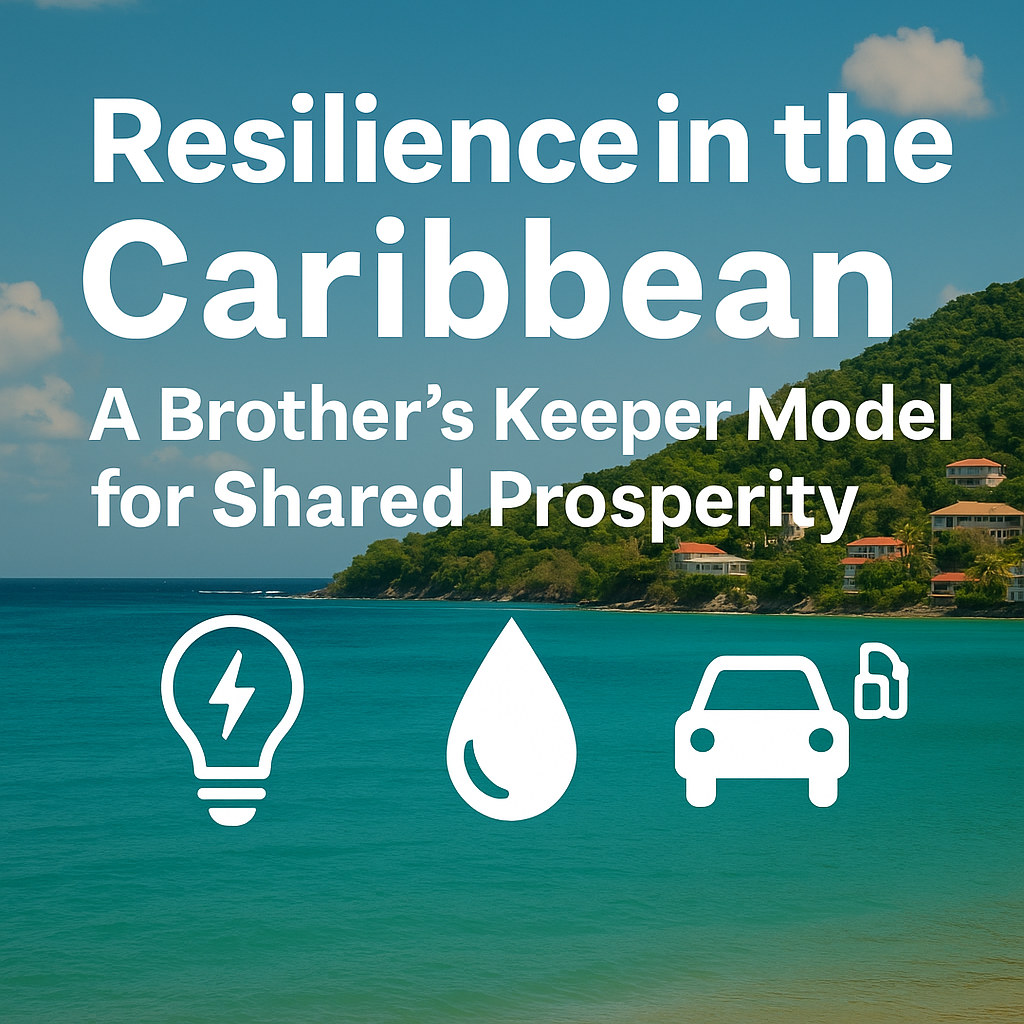
This is where the idea of a Brother’s Keeper model emerges: a policy framework grounded in shared responsibility, mutual investment, and collective protection, one that could radically shorten the timeline to prosperity across the Caribbean.
The Reality We Live With
Across the Caribbean, millions of working people face the same monthly dilemma:
- Pay the electricity bill or buy food
- Pay the water bill or service the mortgage
- Pay for fuel to get to work or fall behind somewhere else
These are not failures of effort.
They are failures of structure.
Income alone does not reflect the real cost of living. And when utilities, electricity, water, gas, and transportation become unstable or unaffordable, families fall behind, resilience erodes, and generational setbacks occur.
We talk often about personal responsibility.
But resilience is not built in isolation, it is built in systems.
What If Utilities Were Treated as Productivity Infrastructure?
Imagine a Universal Utility Support System, designed not as welfare, but as productive infrastructure, much like roads, ports, or telecommunications.
A system based on one simple idea:
If people have guaranteed access to essential utilities, they are more productive, more stable, and more capable of contributing to the economy.
This is not charity.
It is shared investment.
How a Brother’s Keeper Model Could Work
1. A Universal First Tier: The Foundation of Dignity
Every working household would automatically qualify for a base level of utility access, designed around real human needs, not luxury.
For example:
- Electricity: Average monthly kilowatt usage for two people
- Water: Average monthly consumption for two people
- Fuel: Enough non-luxury fuel (e.g., 87 octane) to commute 50 km per day, roughly 1,000 km per month
This first tier represents basic functionality, not excess.
It ensures that:
- People can live
- People can work
- People can plan
Without fear that a single bill will derail an entire household.
2. Contribution Through Work, Not Survival Pressure
Access to this system would be activated through employment.
Every working person contributes:
- A modest percentage of income (for example, 5%) is deducted directly from payroll
- This contribution activates universal utility benefits
In return, workers receive:
- Guaranteed baseline access to electricity, water, and transportation energy
- Stability that supports productivity rather than punishes it
This creates a closed-loop investment:
- You work → you contribute → you receive stability → you work better
3. Tiered Choice, Not Forced Equality
This is not a one-size-fits-all system.
Households can:
- Stay at the base tier
- Or voluntarily move to higher tiers
Want more electricity?
Want additional fuel?
Want higher usage thresholds?
You simply opt in and pay more through payroll deductions.
Importantly:
- Two working adults in one household both contribute
- But base benefits do not double automatically
Why? Because the household already meets basic needs through one tier.
Additional benefits require intentional choice, not accidental over-consumption. The only adjustment would be more fuel, but everything else remains the same, and a combined tax of 10% goes to the benefit pool. Win-win.
To ensure equity and long-term sustainability, the system would be supported by a modest, consumption-based contribution applied across society. A small surcharge, approximately 1.5–2% on purchases , would help capture participation from informal economic activity and non-traditional income earners who may fall outside standard payroll systems.
This approach recognizes that not everyone is formally employed. Retirees, the unemployed, and others in similar circumstances would require a parallel social framework, likely with lower baseline benefits and consumption thresholds. In some cases, working family members could voluntarily extend coverage by contributing higher premiums through employer payroll deductions or pension-linked contributions.
In this way, responsibility is shared without exclusion.
Everyone contributes.
Everyone protects the system.
Why This Model Builds Faster Resilience
Traditional economic models focus on outputs:
- Growth first
- Stability later
A Brother’s Keeper model focuses on inputs:
- Secure utilities
- Reduced cost-of-living pressure
- Immediate household stability
When people are not consumed by survival stress:
- They save more
- Invest more
- Educate more
- Take entrepreneurial risks
- Stay healthier
This accelerates prosperity, not in decades, but in years.
From Individual to Island-Wide Resilience
Resilience does not start at the national level.
It starts in households.
Households form communities.
Communities form districts.
Districts form parishes.
Parishes form nations.
When the base layer is protected, resilience compounds upward.
This is how islands become stronger, not just economically, but socially.
A New Caribbean Social Contract
This idea may not exist anywhere else, yet.
But innovation rarely starts with permission.
It starts with imagination.
A Brother’s Keeper model reframes development as:
- Shared responsibility
- Mutual investment
- Equal access to the tools of productivity
Not everyone will become wealthy.
But everyone will have a fair shot, not by luck, but by design.
And perhaps that is the most Caribbean idea of all:
We rise together, or not at all.
Expected Questions
There are important questions this model naturally raises, and they are worth serious discussion:
- How would this system scale at a national level?
- What would the fiscal modelling and long-term cost projections look like?
- How would existing utility providers be regulated, restructured, or renegotiated within this framework?
These are not obstacles to the idea; they are the next steps, and they are worth the conversation.
“ Resilience is not about surviving storms alone.
It is about building systems where no one has to face them unsupported- Ajeen Beckford”.


Create Your Own Website With Webador